Category: Reflections

  • Freedom and Responsibility

    Freedom and responsibility go together; you can’t have one without the other.

    Change is also a form of freedom – when we welcome it.

    So, freedom is the ability to choose, take responsibility for our choices and grow through change.

    Simple to understand. Challenging to live.

  • Roots and Routes

    We spend a lot of time thinking about our roots and where we come from.

    But our lives are shaped just as much by the journeys we take, the places we go, and the people we meet.

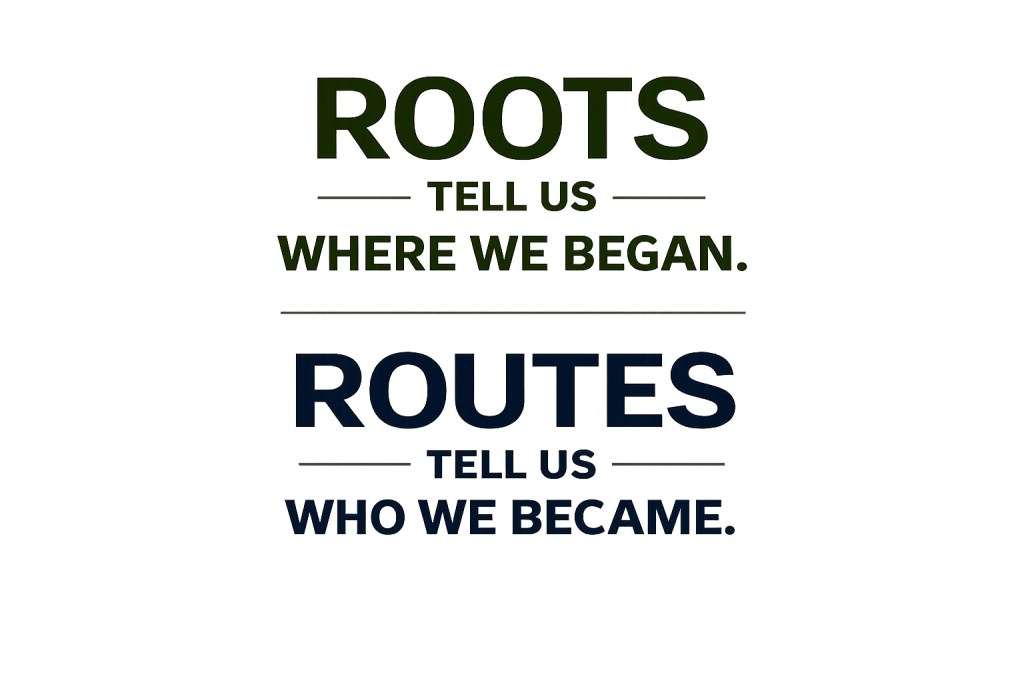
    Our roots tell us where we began. Our routes tell us who we became.

  • We live in a time when involution is more important than ever

    Modern life encourages disconnection — from our bodies, our inner voice, and nature.
    Productivity is glorified.
    Doing is valued over being.
    Technology overwhelms intuition.
    Constant input drowns out inner wisdom.
    Identity becomes fragmented, shaped by algorithms.

    We need to remember who we are.

    Involution is being with yourself — fully and honestly.
    It’s not about escaping the world, but coming home to yourself within it.

    Involution is sacred solitude — and we all need it.

    Sacred solitude is how we rebalance, restore, and remember.
    It’s the quiet act of being fully present with yourself.

  • How to Love Your Body

    We spend a lot of our lives worrying about how our bodies look. Not because we chose to—but because, somewhere along the way, we learned that how we look matters more than how we feel.

    We learn it early. At home, in school, and later through social media. It’s not always said out loud, but it’s there—in comments, comparisons, and the quiet understanding that some bodies are “better” than others. Over time, this voice becomes our own. We stop questioning it and start believing it’s just the truth.

    But what if it isn’t?

    We are all living in different bodies, yet most of us grow up feeling like the one we have isn’t quite right—that there’s always a better version we should be working toward. And so, we spend our time trying to fix something that was never broken.

    The female body is incredible. It can lose blood every month and keep going. It can grow a life and bring it into the world. And still, too many girls grow up feeling like their bodies are something to fix.

    The male body is incredible too. Strong, capable, resilient. And still, too many boys grow up believing their bodies are something to hide or be ashamed of.

    Somewhere along the way, we learned to look at our bodies as problems instead of partners.

    Instead of criticising your body, what if you started speaking to it differently?

    • Thank you for keeping my heart beating, even when it was broken.
    • Thank you for every instinct I felt in my gut.
    • Thank you for keeping me standing when I felt like falling.
    • Thank you for staying with me, even when I pushed you away.
    • Thank you for carrying me through everything I’ve lived through.

    Your body has been there for you your entire life. It has never left you, no matter how you’ve treated it.

    Spend time seeing your body as it is. Not dressed, not hidden—just as it exists. It’s hard to feel comfortable in something you avoid looking at. Wrinkles, lines, scars, marks, softness, changes—they are not flaws. They are evidence. They are signs of a body that has lived.

    Your body is not something to decorate. It’s something that carries you.

    Don’t restrict food in a way that punishes your body. It won’t cooperate—it will push back. Your body is not against you. It’s always trying to support you, even when you’re not listening.

    Stop forcing yourself into things that don’t feel right, whether that’s food, clothes, or expectations. Wear what makes you feel good. Eat what feels right for you. Live in a way that works with your body, not against it.

    If social media makes it harder, step back. You don’t need to constantly see bodies that make you question your own. You are allowed to create space for yourself.

    Your body was never the problem. The way you were taught to see it was.

    Start small. Once a week, write down something you appreciate about your body—not for how it looks, but for what it has done for you.

    Your body is your home. It’s where you live your entire life.

    It deserves your respect.
    It deserves your care.

    And so do you.
  • Choosing to Live for Yourself

    At some point in life, many people confront a difficult question: why am I living the life I’m living?

    For some, the answer is simple. For others, the answer is less clear. Life can become a series of expectations — from family, society, culture, or circumstance. We follow paths that others believe are right for us: school, career, marriage, stability. Often these paths work well. But sometimes they leave people feeling that their life no longer belongs to them.

    When people feel powerless or trapped in roles that do not reflect who they are, despair can follow. Sociologists have long argued that weak social ties, isolation, and lack of belonging can deepen this sense of disconnection. When a person feels they have no control over their life, they may begin to question its meaning.

    Yet this crisis can also become a turning point.

    Confronting the limits of one’s life can force a deeper question: What do I actually want? The moment someone realises that they have the right to live differently can be the first step toward reclaiming their life.

    Living authentically does not mean rejecting others or abandoning responsibility. It means recognising that a meaningful life cannot be built entirely on the expectations of others. At some point, people must decide that their life is their own.

    Not everyone will follow the same path. Parenting is not for everyone. University is not for everyone. A traditional career is not for everyone. Some people find meaning through relationships and family; others find it through creativity, independence, or solitude.

    What matters is not the specific path but the freedom to choose it.

    Learning to listen to oneself,  to understand one’s own values, limits, and desires, is an important step toward living authentically. When people begin to see themselves as worthy of care and respect, they may find new reasons to live differently and more fully.

    Life does not always unfold according to the scripts society provides. But that does not make it meaningless. Sometimes meaning appears only when we take responsibility for our own lives and begin to shape them consciously.

    Choosing to live for yourself is not selfish.

    It is the beginning of an authentic life.

  • Life Didn’t Turn Out as Planned?

    Most people carry high expectations for their lives and often place unreasonable demands on themselves.

    We are taught, sometimes subtly and sometimes directly, that life should follow a certain path: education, career, success, stability, happiness. When reality doesn’t match that imagined script, many people feel they have failed.

    But perhaps the real challenge is learning to see life as it actually is, rather than constantly comparing it to what we hoped it would be — or what others hoped for us.

    Much of the stress, anxiety, and quiet suffering people carry may come from the distance between expectation and reality. Accepting our lives and abilities as they are does not mean giving up. It means letting go of the pressure to live a life that may never have belonged to us in the first place.

  • CURRICULUM VITAE — FAILURES EDITION

    Because the highlight reel doesn’t tell the whole story.

    Name: Tina Brescanu
    Objective: To keep showing up, learning and creating.

    Experience

    Job Seeker (since redundancy)
    • Applied for hundreds of jobs; secured a handful of interviews.
    • No offers yet — but learned the art of resilience and rewriting cover letters in my sleep.

    A Stint in the Corporate World
    • Failed to fit in, didn’t understand the jargon, and couldn’t appreciate the infantilisation of adults in the workplace.
    • Allergic to KPIs, buzzwords, performance reviews, “circle back,” “touch base,” and other corporate rituals.
    • Learned that pretend urgency and scheduled enthusiasm are not my natural habitat.
    • In hindsight, redundancy wasn’t failure — it was freedom.

    Author — 20+ Books (ongoing)
    • Wrote over twenty books, none of which became bestsellers.
    • Consistently failed at marketing because writing felt more meaningful than algorithms.
    • Created Involution Labs as a way to store all my far-out ideas — not a failure, but something that grew out of failure. It became a way of holding myself accountable, and now I’m designing courses from that ever-expanding creative ecosystem.

    Various Online Work (survival era)
    • Took on various online work during difficult periods, including emotional labour and boundary-testing roles that taught me more about human psychology than any textbook ever could.
    • Learned resilience, communication, and the courage to navigate unconventional spaces.

    Print Journalist Trainee
    • Trained for a world of ink and presses… just as the industry went digital.
    • Failed to build the professional network needed to pivot when everything changed.

    Full-Time Parent (career break)
    • Managed small humans with complex needs and strong opinions.
    • Gained skills in management, conflict resolution, diplomacy, advocacy, and negotiating with multiple authorities.
    • Failed to convince employers these were “real” workplace skills.

    Early Career Misstep (mid-90s, Ireland)
    • Posted a job ad titled “Swedish girl looking for work.”
    • Failed to anticipate the replies this would generate.
    • Learned the importance of precise wording.

    Early Education + Work Life Wanderer
    • Left school early, failed to get on the straight-and-narrow career path.
    • Moved from one job to the next — quirky, fun, physically demanding work like grave digging, baking and farming.
    • Moved from town to city, from Sweden to Finland, and eventually Ireland.
    • Didn’t get the posh job. Cleaned toilets in a caravan park in Wexford before starting in the home care business, where I failed to keep a “professional distance” and instead made friends with everyone I encountered.

    Education

    • Learned that success is never linear.
    • Learned that failure isn’t the opposite of success,  it’s part of it.

    References

    My children — they can vouch for my authentic parenting style, and will give both the positive and the negative, because authentic parenting is about being real.

  • Love Education

    Love Education

    None of us is shown or taught how to love, but we should be. We may learn facts and skills in life, but rarely do we learn the deeper skill of loving. We can choose to live without sex, but we can’t live without love. How to love deeply and broadly is what we need—and what the Earth needs too. We must learn how to love strangers, how to love nature, and how to love everything we encounter.

    Our goal in life should be to make love. Not just in the romantic or physical sense, but in the way we move through the world. We can learn to live in love without being in love. Turning living into loving is a lifelong path.

    Yet society’s idea of love often misleads us. We are taught that love is something that happens to us, a reaction when we encounter something “deserving” of love. But deep love is not a rare event to wait for—it is something we practice. Don’t wait for the big love. Love the ordinary people and the small things. Loving the ordinary makes it extraordinary. Saving your love until something better comes along is not loving at all.

    If your culture has taught you to hold back—to wait, to make sure who or whatever is “worthy” before you give love—what are you losing out on? Love is not a prize to be earned. Love is a decision. Love is action. Love is a choice you make again and again. And there is no need to be loved back in order to love.

    We should also be careful not to mistake love for its imitations. To seduce is to lead astray—to try to make someone become who we want them to be, instead of loving who they really are.

    True love goes deeper. True love is core love. True love is mutual love. We don’t simply fall in love—we practice love. To love takes energy, especially when love awakens feelings of powerlessness, helplessness, or vulnerability. Real love takes work.

    And yet, this work transforms us. When we are courageous enough to be ourselves with another, to grow and change together, love keeps growing. Passion can ripen into something more real when we dare to take the risk of loving fully. Because real love changes us.

    It is only when we dare to have our heart broken that we can truly love. True love gives and forgives.